top of page
  • Aug 18, 2025

During film school I fell in with a bunch of improv actors through a director I worked with that did sketch. These three men had an improv show at Second City. The premise of the show was that Ithamar - a self-obsessed improv genius - invites a Japanese father-son comedy-duo to LA to perform improv with him on stage at Second City, the duo is called Jetzo. So the show that one might buy tickets to was called Ithamar & Jetzo. The gag is that Jetzo is comprised of a Japanese man in his 50s playing the son, and the father is played by a younger white man in his 40s. They hired me to create an introduction video that would play at the top of the show to provide the context the audience needed before they took the stage. All three were incredible to work with, and their physical comedy was top notch. In order to get the BROLL used in the final edit, I setup an improv experiment where I had Ithamar - who actually teaches an improv class at Second City - invite his class and had him teach his class in the character that he plays for Ithamar & Jetzo, and gave the classmates the direction that they are getting fed up with this guy after a few weeks of his class, and not receiving the kind of instruction they paid for and then just let them all run free and filmed it. Occasionally, I would throw a note out there or have them do something again, but for the most part it was a 45 minute filmed improv thing. It was super fun to make. Below is the intro video we created, and then below that is a trimmed down version of that class - which I found to be a fun watch on it's own. All of this was very meta, and the type of thing that only works in LA, where you can gather an audience of people that are so familiar with the inner workings of improv for this to resonate.


  • Aug 18, 2025

MARCH 2024

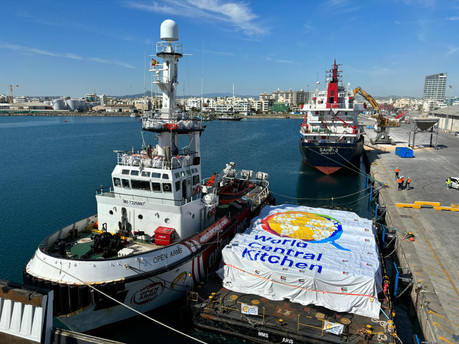
Moving trucks into Gaza was not allowing us to get as much aid in as was needed, so we sought alternate routes. This led me to Cyprus. In fact, it all came together so fast, that my return to Egypt from Bahrain was cancelled and I flew straight from the F1 race in Bahrain to Cyprus. In Cyprus, we were going to buy a barge, buy food, put the food on the barge, pull the barge to Gaza where it would be offloaded at a jetty that our team inside Gaza was building. It was an insane idea. We contracted a construction company in Gaza to begin the work on the jetty. It was made of debris from the war and was wide enough to get a crane to the end of it to offload the barge and onto a truck and long enough for the barge to not get stuck in the sand. The boat that pulling the barge was a tug boat called Open Arms, which is also the name of it's owner - an NGO that rescues refugees in the Mediterranean Sea.


For my part I was to buy the food (wherever I could) and then palletize it to the specific needs of loading it onto the barge, then off the barge at the jetty, onto the trucks, and into Gaza as well as the loading operation onto the barge. There is so much about this operation that was crazy. Within two days of arriving I was standing on the dock at Larnaca port, in the rain, at night loading pallets onto a barge with just myself, one colleague and a crane operator. I'm still not sure how this was allowed to happen, as these are all union jobs, and furthermore having no training in really anything to do with maritime logistics. But there we were.


I'm going to get a little inside baseball here for a moment because it will become relevant later, but also because this is my blog and I can write whatever I want. The specific needs for the palletization turned into a an on-going problem to solve. There were many elements involved. A typical pallet is wrapped with plastic wrap 3 or 4 times to hold all the goods onto the pallet as its forklifted from warehouse to truck and truck to warehouse. This was no good enough for this operation. The journey of these pallets was as follows (and this is only once we've received them):

  1. Warehouse in Larnaca

  2. Truck to Larnaca Port

  3. Truck to IDF scanner in Larnaca Port

  4. Customs controlled warehouse in Larnaca Port

  5. Truck to Barge in Larnaca Port

  6. Crane onto Barge

  7. Cross the Mediterranean Sea (open to the elements)

  8. Crane off the Barge onto a truck at the end of a Jetty

  9. Warehouse in Gaza

  10. Truck in Gaza to final recipient


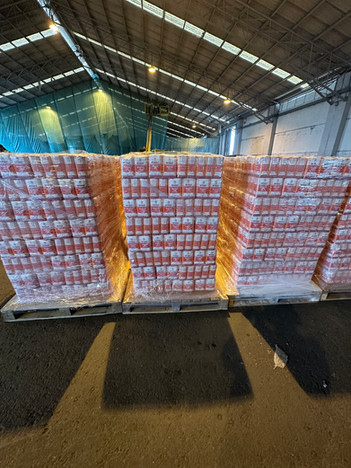
And this is best case scenario. Often there were other nodes along that workflow for various reasons. And because the offload operation in Gaza on the jetty was not going to be anything resembling the controlled environment of a professional port with Stevedors (the union port workers) the straps by which the crane could pick the pallets up needed to be embedded into the pallets. My first two days were focused on how best to palletize the pallets for this operation. This included putting a pallet ontop as well, and ratchet strapping the two pallets into a sandwhich with the goods in the middle and the crane straps in the mix, and then a whole bunch of pallet wrap.


Our first barge was only able to hold 100 pallets. This was Phase One: Open Arms pulls barge to Gaza, they anchor several hundred meters off shore. Then their zodiacs (two smaller single motor boats that they lower into the water) push the barge to the jetty to be offloaded. This operation in total was about 130 hours round trip. So while we were doing phase one we were also trying to spin up phase two. Which was even more insane. Phase two was that we got a bigger boat. This was called the Jennifer, and inside of that boat we would lower into it a crane. The Jennifer could hold about 400 pallets plus the crane. We would load up the Jennifer, then - while at sea - the Jennifer would restock the Open Arms barge for faster deliveries to Gaza.


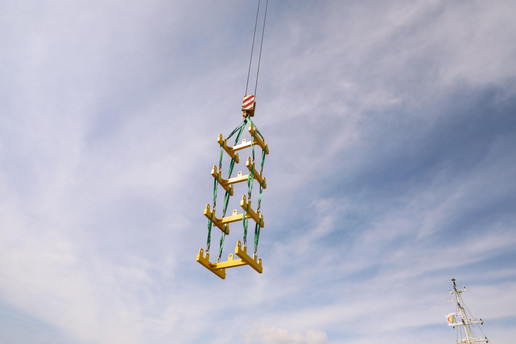
But back the pallets. Part of this required us to design what we called The H. It was a thing to attach to the end of the crane to lift pallets and we needed to stock them up with one in Gaza. We were quite proud of this. We also rented a warehouse at the port. We actually rented two warehouses at the port. Previously they were mostly filled with pigeons. This was a working port, but Cyprus's main port was in Limassol a couple hours up the road, and as Cyprus is not that large to begin with, this port was not all that busy.


We were not the only organization that was attempting to move aid from Cyprus to Gaza. To be clear, no one had done it yet, but there were efforts - all in their own way. Something like this does not simply happen on it's own. We needed to coordinate with the Cypriot government, the Israeli Defense Force [IDF], the United Nations [UN], the US Army and USAID as well as deal with the presence of this mysterious for profit company called Fogbow. The first plan presented to this coalition of abbreviated organizations was from this company Fogbow - which we started calling Fogbro. It seems there is more information about them now, but at the time, they were almost nothing but a single page website. What we knew was that it was a new company formed in the aftermath of the war of former US Service members. Their intentions were opaque, but they always had a presence. They made a proposal (for a hefty contract I'm sure) to setup a logistical operation that included passage from Cyprus to Gaza and included similar elements - boats, barges, jettys/piers, trucks, cranes, etc. They were denied. This was around the same time the US Army was starting to discuss their plans for a building their [now] infamous floating pier. A $500 million dollar operation that would take 3 months to setup and would ultimately be a resounding failure. More on that later.


Our philosophy of emergency aid did not compute the timeline of 3 months. Like I said, within two days of arriving in Cyprus, I was loading 100 pallets onto a barge at Larnaca port. Now, this Phase One plan was a couple of weeks in the works, around the same time Fogbow was making their proposal, we were making ours as well. Whatever their reasons, and I could think of several, the Cypriots, the IDF, and the UN approved ours instead of Fogbow. It was less than a week after the this approval I was loading the first barge of phase one.


As part of phase one and spinning up phase two, we needed warehouse space and a lot more product. I purchased over 2000 pallets of food from international suppliers. We needed to not only receive this product, but palletize it to our needs, and ID and track each one. This was the operation I was running at our rented warehouses at the port. I was also designing and building the digital tool we were using to do this as we were doing it.


On March 12 the Open Arms set sail for Gaza pulling our barge. Incredibly, and against all possible logic, they managed to offload all pallets on the jetty and return back to Cyprus. It was a miracle. And the stories the Open Arms crew - who are in the truest sense of the word (and with none of the misconduct or illegal activity) are a band of pirates - told us were amazing. The waves at the jetty were intense, smashing and thrashing the zodiacs and the barge against debris from missile strikes that was the jetty: concrete chunks with rebar sticking out. They held the barge in place for 10 hours, while the Gaza team unloaded the barge with the crane on the jetty.


The moment when the Open Arms crew returned to Larnaca after this mission was one of the greatest moments of our lives. Welcoming them back, after this monumental achievement we pulled off, an achievement that goes beyond logistics, or maritime operations, but which was a political minefield, it was the first time a boat had crossed the IDF's maritime barricade surrounding the shores of Gaza in over 15 years, and we delivered 100 pallets of desperately needed food to hungry people doing it. This was an otherworldly accomplishment. And I remember standing there at the port, and someone started playing music, and we just stood there and enjoyed the moment as a teem. It was one of the coolest moments of my life.


  • Aug 17, 2025

Before describing Phase II, I want to take a moment to talk about counting pallets. Counting pallets is an art, not a science. It may seem like a simple thing to count pallets. I can assure you it is not. It is one of the hardest things in this life. This was certainly made more difficult due to the fact that we were building a digital tool as we were using it, but at some point you still need to physically count pallets and it seems impossible. Many late nights were spent walking across pallets in warehouses and on ships, taking one step, counting, another step, counting. Somehow two people doing this will NEVER arrive at the same number. MARCH/APRIL 2024

Roughly two weeks later, the Jennifer set sail—but getting there was its own ordeal. Phase Two required loading all the pallets onto the ship, offloading them, and then loading them again. This was driven by protocol. Every pallet had to be scanned by the IDF using large X-ray scanners—trucks driving through massive scanning units. There’s a whole story here about Italian scanners versus U.S. scanners, but that’s for another time.


Once scanned, pallets were stored in a customs-controlled warehouse—functionally just a locked warehouse sealed at the end of the day. Pallets could not be moved again unless an IDF representative was present to break the seal and oversee the transfer onto the Jennifer.

The Jennifer itself had two cargo bays. Each bay had a ceiling that opened and closed, along with manholes for access, all of which were lockable. Once loading stopped for the day, a small ceremony followed every time: a representative from customs, one from the UN, one from the IDF, and myself would stand there while the crew locked the cargo bays. Customs would apply a seal, and all of us would photograph it being sealed.


The “seal,” to be clear, was not much of a seal—more a piece of thread designed to break if someone entered. And one night, someone did. A drunken sailor on the Jennifer decided—for reasons unknown—to go into a cargo hold. He broke the seal. That meant everything had to come off, be rescanned, and be reloaded.


Aside from the drunken sailor incident, Phase Two mostly went smoothly. Until it didn’t.

They launched on March 30. The Open Arms and the Jennifer sailed together. The Open Arms was fully loaded for its first delivery, after which it was meant to return to the Jennifer, anchored just outside the IDF maritime barricade, restock at sea, and continue running back and forth.


But on April 1, after the barge was offloaded successfully for the second time, our team on the Gaza side was heading back to their safe house when they were targeted by direct drone strikes from the IDF. All seven of them were killed. And in contrast to the moment when the Open Arms returned from it's first trip back to the Larnaca port, when they returned this time, it was tragedy.


It is a strange thing when something is personal, professional, and global all at once. These people were my friends and colleagues, and the world knew what had happened. We shut down the operation, placed all the food we had purchased into storage, attended services around the world, and went home to recalibrate.


©2026 Dylan dugas
bottom of page